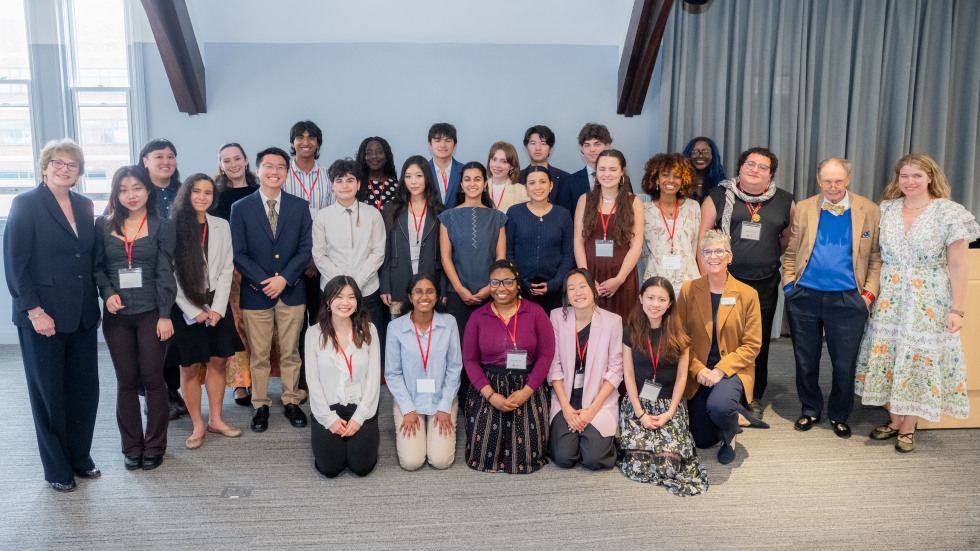
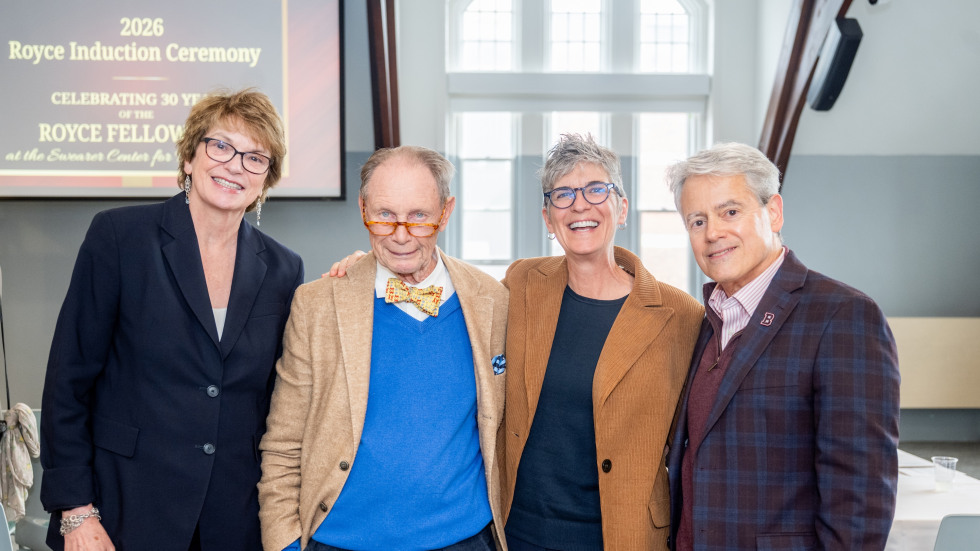
Earlier this month, students, faculty mentors, alumni and families gathered to welcome Brown’s newest cohort of Royce Fellows. These 27 undergraduate students are preparing to spend the coming months conducting independent community-engaged research projects of their own design in locations across the United States and around the world.
This year’s induction ceremony also celebrated the 30th anniversary of the Royce Fellowship, a long-running undergraduate research initiative established in 1996 through the generosity of Charles (Chuck) Royce ’61 P’91 P’94 P’08 GP’26.
Since its founding, the Royce Fellowship has supported more than 600 students pursuing self-designed projects across disciplines and geographies. The fellowship provides funding, faculty mentorship and cohort-based support as students carry out their research that often extends beyond campus into communities, archives, laboratories and field sites around the world.
“You'll step into projects not defined by certainty, but by curiosity,” said Mary Jo Callan, Vice President for Community Engagement and Stark Family Executive Director of the Swearer Center, during opening remarks. “The questions you ask matter as much as what you uncover.”
This year’s fellows represent a wide range of concentrations and research interests. According to Royce Fellowship Director Grace Argo, the cohort includes students working across STEM, the social sciences, the arts and the humanities, with projects taking place both locally and internationally.
“Ten inductees are undertaking international projects this summer,” Argo said, with research sites spanning locations from the Caribbean to East Asia.
While the projects differ widely in subject matter, many share an emphasis on co-learning and public-facing inquiry, work that connects scholarship with broader social, historical or community questions.
During the ceremony, Brown University President Christina H. Paxson reflected on the fellowship’s history of supporting ambitious undergraduate research, noting that Royce projects frequently evolve as students encounter new information, constraints or relationships in the field.
“Sometimes projects turn out exactly like you planned,” Paxson said. “And sometimes they don't.”
“The journey is never a straight line,” Chuck Royce also emphasized, telling students: “one of the benefits of the program is you learn how to weave and change and adapt and move on.”
Royce described the fellowship less as a pathway to polished outcomes and more as a framework for independent learning.
“It’s all about learning how to learn,” he said.
Callan reflects on the partnerships students create with faculty mentors, each fellow working closely with an advisor who helps guide their research development, methodology and fieldwork planning.
“To our faculty mentors: thank you for your guidance of our students as they navigate their projects,” Callan said. “Your engagement and support directly contribute to the success of these students.”
For many fellows, the program creates a bridge between classroom learning and independent inquiry, with projects often inspired by coursework, personal experience or long-term academic interests, then expanded into sustained research over the summer and academic year.
Thirty years after its founding, the Royce Fellowship continues to provide students with space to test ideas and conduct research focused on co-learning and co-creating.
As the 2026 cohort begins its work, students join a growing network of Royce alums whose projects have taken them into hospitals, neighborhoods, laboratories, archives and community organizations. The fellows continue to direct their research around questions more than answers, creating community and lasting relationships through their work.
Applications for the Royce Fellowship are usually due in March. Explore eligibility and application details.