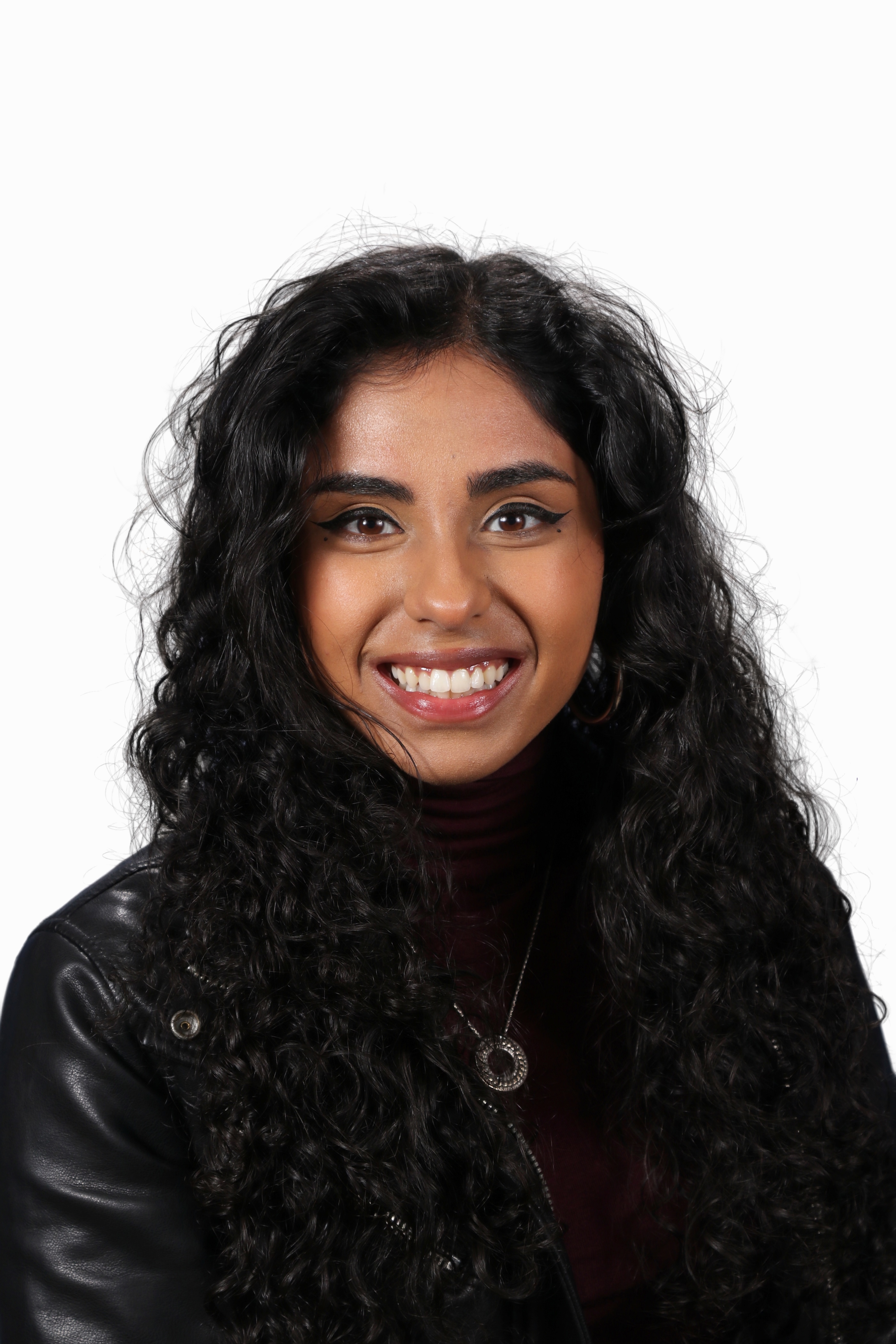
When Rishika Kartik ’26, Royce Fellow, Schwarzman Scholar and Newman Civic Fellow, talks about accessibility, she doesn’t start with tools or standards. She starts with people, what they know, what they’ve built and what they need in order to thrive. That foundation began for her in high school, volunteering at the Colorado Center for the Blind, where she helped to lead the arts programming.
“At the [Colorado] Center for the Blind,” she says, “one of the big philosophies that inspired me was understanding that every person has inherent value and potential. Rather than a deficit-based approach to disability–trying to make people ‘less blind’–we focused on agency and assets.”
That philosophy continues to shape her work. In community-engaged settings, she strives to identify what partners already do well and amplify what others have spent years building. She also carries forward two additional lessons: collaboration and curiosity.
“There’s a very salient lesson of interdependence,” she says. “No one gets anywhere without relying on others and collaborating. And it’s always better to ask questions than to sit with assumptions.”
Those three commitments–asset-based practice, collaboration and curiosity–now inform a wide body of work spanning community health navigation, legislative advocacy, research and teaching. Based on this impactful work and her commitments to community engagement, Kartik was selected to join this year’s cohort of Newman Civic Fellows, a national program that convenes student leaders committed to public problem-solving.
Through the fellowship, Kartik continues to weave together storytelling, disability and design and community engagement toward the goal of making systems work for the people who use them.
Early Lessons in Community-Led Design
At Brown, Kartik created an independent concentration in Disability and Design that deliberately bridges medical and social models of disability. The pathway grew from her early interest in accessible design and a belief in education rooted in curiosity rather than prescription. “I don't believe in education that's didactic,” she says. Brown’s open curriculum aligned with her experience as a student teacher working with blind students, reinforcing her conviction that everyone is born with curiosity and that learning flourishes when students find what motivates them.
She arrived intending to study accessible design. “I loved math and I loved creating things, and I liked that there was a unique blend between arts, social sciences and STEM– and it also was doing work in service of a community that I cared really deeply about.”
The theme running through her coursework and projects is pragmatic and people-first: connect knowledge to users, connect users to systems and design with communities, not for them. Accessible design is not always recognized as a formal discipline, which can limit incentives to publish. Kartik is working to expand that scholarship by conducting research, presenting and contributing to a growing body of evidence-based recommendations.
Health navigation as civic design, Connect for Health (C4H)
Kartik serves as an advocate and team coordinator with Connect for Health (C4H) at the Center for Primary Care in Rhode Island. “Connect for Health has been one of the highlights of my time at Brown,” she says. She found the program after hearing a jarring data point during a local session on vision rehabilitation: “Among all of the eligible people who are blind in Rhode Island, only five percent are receiving the social services that they’re entitled to.” The problem wasn’t a lack of solutions, she realized, but the breakdown between resources and access.
Day to day, she supports a small caseload of patients each semester–sometimes across multiple terms–helping them navigate benefits and systems: WIC, SNAP, SSDI and SSI, translation for niche languages, and, at times, simply being a consistent person to check in with when life is complicated. “Sometimes people just need someone to talk to and to realize that someone cares about them,” she says, recalling cases ranging from routine benefits navigation to more complex domestic-abuse immigration matters.
After her first year, she stepped into a mentorship role, guiding 10–15 student advocates through weekly meetings focused on resource coordination and case troubleshooting. She emphasizes boundaries alongside accountability. “You can’t pour from an empty cup,” she reminds them.
At the national level, Kartik participates in ASPECT, a Prevent Blindness patient-engagement program that pairs people with lived experience of vision loss with clinicians and advocates. “We empower patients to tell their stories,” she says. “Self-advocacy is the bridge from personal experience to policy.”
She joined ASPECT’s legislative team on Capitol Hill to advocate for H.R. 8400, a bipartisan bill that would establish nationwide childhood vision-loss screening. Her role focused on translating stories and technical data into policy messages that mobilize support. “Progress is slow,” she says, “but it’s moving.”
Designing With Communities, Not for Them
With mentors including Professor Sarah Skeels (School of Public Health), Kartik co-created and co-taught “Blindness, Arts, and Media”, a course exploring how blindness is represented in arts and media and how creative practice can improve access. For the final, students produced podcasts with blind community members engaged in design.
A year later, she co-taught “Gerodesign,” focused on designing systems, products and technologies for older adults. The work connected naturally with accessibility and vision loss. “As people age, vision changes,” she notes. “We both had a lot to learn from each other and from our community partners.” She also earned an Undergraduate Teaching and Research Award to help develop graduate-level disability-studies curriculum examining how medical diagnoses carry political histories.
“I’ve been working with Deb Mills-Scofield on Brown’s design engineering track to make accessible design a visible pathway,” Kartik says. “Even if you’re pre-med, a lawyer, an engineer—learning the basics of disability and accessibility changes how you practice.”
Research and art as connective tissue: diabetes, vision and usable tech
Part public art, part research, “The Blind Urban Subject” began as a collaboration with Royce Fellow Daniel Solomon ’26, who is legally blind, and Brown-RISD dual-degree student Zoe Goldemberg ’27. The team modified a sightseeing tower viewer to simulate four common eye conditions (cataracts, glaucoma, macular degeneration and diabetic retinopathy). The installation debuted on the corner of Angell and Thayer in Providence and later traveled to New York City.
One moment has stayed with her. “A woman pulled away from the viewer with tears in her eyes. Her mom had recently passed away with cataracts. She said, ‘This was the first time I got to step in her shoes.’”
For Kartik, the project also challenged the misconceptions that disability is binary. Visual impairment exists along a spectrum, and design can make environments more comfortable and usable across that spectrum. Her research continues to reach across silos. The summer before her junior year, she worked with Dr. Gregory Forlenza at the Barbara Davis Center, one of the world’s leading institutes for diabetes care, to study how people with vision loss use continuous glucose monitoring (CGM) technologies.
Diabetes can cause vision loss and vision loss can complicate diabetes management, creating a feedback loop. Kartik and her collaborators examined how accessible current technologies are and where gaps remain.
“We realized there was a big need to improve the technology and the surrounding systems,” she explains. “Sometimes it’s as simple as showing providers how to turn on voice control and verifying that the app is compatible, an immediate, no-cost fix. Other changes are longer-term and require product design and better clinical data.”
“Blind people are independently using CGM technology,” she says. “There’s a gap between what people can do and what some clinicians assume they can do.” Parts of this research have been published in Rehabilitation Psychology, Diabetes Technology and Therapeutics and the Journal of Visual Impairment & Blindness. But she emphasizes that stronger, more consistent reporting on visual impairment is still needed to inform evidence-based recommendations.
Storytelling as a design method
Kartik often returns to narrative as an engine of change, crediting, in part, the preparation of her widely viewed TEDx talk, Creativity Is More Accessible Than Meets the Eye, for sharpening that insight.
“How do you identify the root of this call that you're trying to sell, reach the right people to get your message out there and then ultimately mobilize to create change?” she asks.
That storytelling lens has personal roots, too. Members of her extended family have experienced vision loss, and she has watched how context and resources shape outcomes. “With the right resources, people with the same diagnosis can lead vastly different lives.”
This year, Kartik also received the 2026 Campus Compact Student Leadership Award and was selected to present at the poster session. Her presentation, "How to Creatively Engage Audiences and Make Your Ideas Stick," explores how creative storytelling can deepen audience engagement and build support for new ideas.
Co-learning through the Newman Civic Fellowship
The Newman Civic Fellowship connects Kartik to a national cohort of co-learners. “It’s a tremendous privilege,” she says. “I’ve collaborated with so many extraordinary people at Brown; the fact that I can expand that by learning with people who are considered top of their university, across different universities from different states, across people of different backgrounds and life experiences, has been so fruitful.”
“Disability is not in isolation,” she says. “You can’t consider it without the criminal legal system, economic development, or homelessness.”
Agency, reciprocity and the work ahead
Much of how Kartik’s approach traces back to lessons she learned early on at the Colorado Center for the Blind, principles that continue to guide her: research, teaching and advocacy.
“Because disability affects everyone, most projects benefit from and so that's how I see my role–as enhancing and uplifting the work that people are doing in general, more specifically applying my accessibility expertise to make whatever they're doing inclusive.”
As a Newman Civic Fellow, Kartik has continued to expand her research and teaching while deepening her community-based work with the Swearer Center. After graduation, she will join the Schwarzman Scholars 2026 cohort at Tsinghua University in Beijing.